
Introduction
The 2026 Tour de France concluded with a spectacular finale that lived up to the race’s legendary reputation. Stage 21 delivered everything cycling fans could hope for—historic landmarks, tactical brilliance, relentless attacks, and breathtaking racing through the heart of Paris. While the final stage of the Tour has traditionally been viewed as a ceremonial procession before a sprint finish on the Champs-Élysées, recent route innovations have transformed it into one of the most exciting days on the cycling calendar.
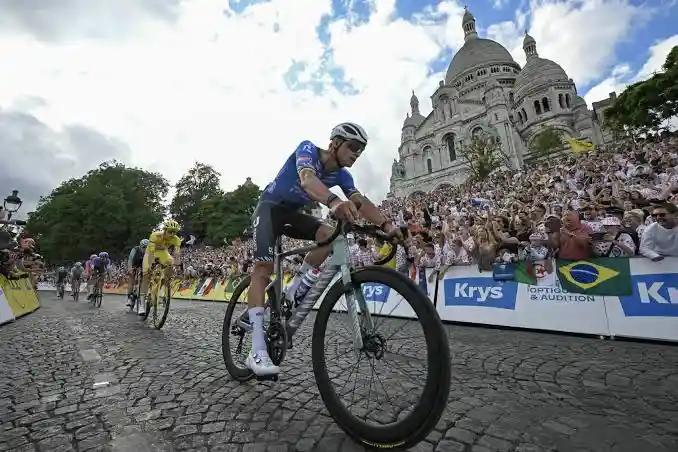
This year’s final stage introduced another dramatic chapter in Tour history. Riders raced through the iconic cobblestone streets of Paris before tackling the challenging climbs of Montmartre, creating opportunities for aggressive racing rather than a predictable sprint. The combination of technical corners, steep gradients, and passionate crowds produced an unforgettable showdown between some of the world’s greatest cyclists.
From the opening kilometers to the dramatic final sprint, Stage 21 showcased why the Tour de France remains the pinnacle of professional road cycling. The battle featured relentless attacks from the yellow jersey, fearless breakaway attempts, and tactical decisions that kept spectators guessing until the very last meters of the race. Based on the official race highlights, the stage emphasized both the beauty and unpredictability of cycling’s greatest event.
Stage 21 Route Overview
Unlike many previous editions that ended with relatively straightforward circuits around Paris, the 2026 route challenged riders with a more dynamic and technical finale. The peloton began and finished in Paris, traveling multiple laps around the famous Champs-Élysées, one of the world’s most recognizable avenues.
For the opening laps, riders followed the traditional circuit around landmarks such as the Arc de Triomphe, maintaining the classic atmosphere that has defined the Tour’s final day for decades. However, organizers once again introduced the demanding climb through Montmartre, significantly changing the complexion of the race.
The Montmartre climb measured approximately one kilometer with an average gradient of around 6.5 percent. Although short compared to the mountain stages in the Alps or Pyrenees, its cobblestone surface and repeated ascents forced riders to expend valuable energy after nearly three weeks of racing.
Another strategic change came with the increased distance from the top of the climb back to the finish line. Instead of a shorter run-in, riders faced roughly ten kilometers before reaching the finish, creating greater uncertainty. Climbers and attackers had more room to maintain an advantage, while sprint teams still had an opportunity to organize a chase.
The result was a course that rewarded courage, tactical awareness, and exceptional endurance rather than simply favoring the fastest sprinter.
Early Attacks Set the Tone
As expected on the final day of the Tour de France, numerous riders attempted to animate the race from the opening kilometers. Rather than waiting for the concluding circuits, several cyclists launched aggressive breakaway attempts, hoping to spend time off the front in one of cycling’s most prestigious stages.
The race featured repeated attacks from riders including Baptiste Wieshofer, Kasper Asgreen, and several other ambitious competitors eager to capitalize on any hesitation within the peloton. These moves reflected the unique nature of Stage 21. While the overall general classification was largely decided, the opportunity to win on the Champs-Élysées remained one of the sport’s greatest achievements.
The peloton, however, refused to allow any early escape significant freedom. Teams with sprinters, along with squads protecting overall positions, carefully controlled the pace. Every attack was monitored, reeled back, and replaced by another ambitious move only moments later.
This constant pattern of acceleration created an unusually aggressive opening phase compared to the ceremonial processions often associated with the Tour’s final stage.
The Green Jersey Takes Center Stage
One of the standout performers throughout the stage was Mads Pedersen, whose aggressive riding perfectly reflected his outstanding Tour campaign. Having secured the green jersey competition through remarkable consistency, Pedersen still showed no interest in simply riding conservatively to the finish.
Instead, he repeatedly joined attacks, contested intermediate sprint points, and actively positioned himself whenever the road became more demanding. Even when additional points no longer significantly altered the standings, Pedersen continued racing with the same intensity that had characterized his performance throughout the entire Tour.
His aggressive approach demonstrated why he had earned the reputation as one of the race’s most exciting riders. Rather than sitting comfortably within the peloton, Pedersen continually looked for opportunities to influence the outcome of the stage.
The challenging Montmartre climb particularly suited his strengths. As a rider known for excelling in the Spring Classics and on cobbled terrain, Pedersen appeared comfortable whenever the gradient increased and the road surface became more technical.
His willingness to attack rather than defend made him one of the central figures of the day’s racing.
Montmartre Changes Everything
The introduction of the Montmartre climb fundamentally altered the tactical landscape of Stage 21.
Unlike traditional sprint finales where teams organize lengthy lead-outs over relatively flat terrain, the repeated climbs fragmented the peloton and encouraged repeated accelerations from the strongest riders.
The atmosphere surrounding Montmartre added another layer of excitement. Thousands of passionate spectators lined the narrow streets, creating an atmosphere more commonly associated with mountain stages than city-center circuits. The deafening cheers echoed through the climb as riders battled over the cobblestones.
Each ascent increased the intensity of the race.
Rather than preserving energy for a sprint, riders began positioning themselves earlier before every climb. Small gaps quickly became significant advantages, while any hesitation could leave competitors struggling to reconnect with the leading group.
The challenging terrain also exposed fatigue accumulated over three demanding weeks of racing. Riders who had comfortably survived earlier stages suddenly found themselves dropped as the pace intensified.
Montmartre transformed what was once considered a predictable final stage into a genuine battle for victory.
Tadej Pogačar Refuses to Settle
Although wearing the yellow jersey and virtually assured of overall victory, Tadej Pogačar demonstrated why he is widely regarded as one of cycling’s fiercest competitors.
Many race leaders would have chosen a conservative strategy, avoiding unnecessary risks before crossing the finish line safely. Pogačar chose the opposite approach.
Instead of defending his lead, he attacked.
As the peloton climbed Montmartre, Pogačar surged toward the front with remarkable determination. His accelerations immediately forced reactions from every major contender. Riders who hoped for a tactical finale suddenly found themselves responding to one of the strongest climbers in the world.
Observers noted how Pogačar appeared determined to win not only the Tour de France overall but also the prestigious final stage in Paris.
His repeated attacks placed enormous pressure on the rest of the peloton. Only a handful of elite riders could match his pace as speeds increased dramatically on the cobbled climb.
Even after nearly three weeks of relentless racing, Pogačar showed no signs of satisfaction. Every acceleration reflected the mentality of a champion unwilling to settle for merely protecting a lead.
Mathieu van der Poel Answers Every Challenge
If there was one rider capable of responding to Pogačar’s explosive attacks, it was Mathieu van der Poel.
Renowned for his power, technical bike handling, and exceptional performances on cobbled terrain, Van der Poel proved once again why he remains one of cycling’s most entertaining racers.
Whenever Pogačar accelerated, Van der Poel immediately closed the gap. Their duel quickly became the defining storyline of Stage 21, captivating spectators lining the streets of Paris.
The pair worked together at remarkable speeds, creating separation from many of the world’s best cyclists. Their combination of climbing ability, technical skill, and fearless racing transformed the final stage into an unforgettable contest rather than a ceremonial celebration.
With every kilometer, anticipation continued to build as cycling fans wondered whether anyone could stop the two superstars from deciding the stage victory themselves.
The Decisive Battle for Stage Victory
As the race entered its closing kilometers, the intensity reached another level. The repeated climbs of Montmartre had dramatically reduced the number of riders capable of competing for victory, leaving only the strongest contenders in contention. Every acceleration stretched the lead group further, and every technical corner through the streets of Paris demanded complete concentration.
The decisive moment came when Tadej Pogačar launched yet another powerful attack on one of the final ascents. His acceleration immediately split the front group, forcing only the most explosive riders to respond. Mathieu van der Poel once again matched the move, demonstrating his exceptional ability on punchy climbs and cobblestone roads.
Behind them, the remaining contenders worked together in an attempt to limit the gap. Riders including Mads Pedersen continued fighting to remain within striking distance, but the relentless pace established by Pogačar and Van der Poel proved difficult to sustain after nearly three weeks of racing. According to the official race highlights, the aggressive attacks on the final climbs became the defining feature of Stage 21, replacing the traditional bunch sprint with an all-out tactical battle.
Paris Provides the Perfect Backdrop
One of the most memorable aspects of Stage 21 was the extraordinary setting. Racing through Paris has always been a symbol of triumph in professional cycling, but the redesigned finale elevated the spectacle to another level.
The peloton passed some of France’s most recognizable landmarks before weaving through narrow streets packed with enthusiastic fans. Thousands of spectators lined every climb, corner, and straightaway, creating an electric atmosphere that inspired the riders to continue attacking despite weeks of accumulated fatigue.
The cobblestone roads added another layer of complexity. Unlike smooth pavement, cobbles require superior bike handling, excellent balance, and constant focus. Small mistakes can quickly become costly, especially at racing speeds exceeding 50 kilometers per hour.
The combination of historic scenery, passionate supporters, and technically demanding roads transformed Stage 21 into far more than a ceremonial finish. It became one of the most visually spectacular stages of the entire Tour de France.
Tactical Brilliance on Display
Stage 21 was not simply a contest of physical strength—it was also a masterclass in race strategy.
Every team entered the stage with different objectives. Some hoped to position their sprinters for victory, while others targeted a successful breakaway. Teams supporting riders in the general classification focused on protecting their leaders from crashes and mechanical problems. Meanwhile, classics specialists viewed the Montmartre climbs as an opportunity to attack rather than wait for a sprint.
This mixture of ambitions created an unpredictable race. Breakaways formed and dissolved, attacks came from multiple directions, and riders constantly adjusted their tactics depending on the changing situation.
Positioning became especially important before each climb. Entering Montmartre near the front reduced the risk of getting caught behind splits, while poor positioning often forced riders to waste precious energy chasing back onto the leading group.
The stage highlighted one of cycling’s greatest qualities: success depends not only on fitness but also on intelligence, teamwork, timing, and split-second decision-making.
Why the New Stage 21 Format Is a Success
For decades, many fans viewed the Tour de France’s final stage as largely ceremonial. While winning on the Champs-Élysées remained prestigious, the overall general classification was rarely challenged on the final day.
The introduction of the Montmartre climb has changed that perception entirely.
Instead of a predictable sprint, riders now face a course that rewards aggressive racing and creates opportunities for different types of competitors. Climbers, classics specialists, puncheurs, and powerful all-rounders all have realistic chances to influence the outcome.
This format also benefits spectators. Fans watching from the roadside or on television witness genuine racing rather than a relaxed procession followed by a brief sprint. Every lap carries the possibility of another decisive attack, making the finale significantly more engaging.
Judging by the excitement generated during the 2026 edition, the redesigned route has become one of the Tour’s most successful recent innovations.
The Champions’ Mentality
Perhaps the greatest takeaway from Stage 21 was the mentality displayed by the race’s biggest stars.
Despite already wearing the yellow jersey, Tadej Pogačar refused to ride conservatively. Instead, he repeatedly attacked in search of another prestigious victory. His willingness to race aggressively until the final kilometers reflects the mindset that separates great champions from ordinary competitors.
Mathieu van der Poel matched that determination by responding to every acceleration. Rather than settling for a respectable finish, he embraced the challenge and continued fighting for the stage victory.
Mads Pedersen also demonstrated remarkable resilience. Even after securing the green jersey through weeks of consistent performances, he continued racing aggressively rather than protecting his achievements.
These performances reminded fans that elite cycling is driven by ambition, resilience, and an unwavering desire to compete.
Cycling, Performance, and Mental Strength
Professional cycling places extraordinary demands on athletes. Riders spend countless hours training, competing in changing weather conditions, and enduring both physical discomfort and mental fatigue over the course of a three-week Grand Tour.
Success at the highest level requires more than exceptional fitness. Focus, emotional resilience, recovery, and mental well-being all play essential roles in helping athletes perform under immense pressure. The ability to remain calm during tactical battles, recover from setbacks, and maintain confidence after difficult stages often separates champions from the rest of the field.
Mental wellness is equally important outside of professional sports. Whether you’re training for a cycling event, pursuing personal fitness goals, or simply striving for a healthier lifestyle, prioritizing both physical and mental health can make a meaningful difference. Resources that encourage overall well-being, including those available at Rager’s Mental Health, highlight the importance of maintaining balance while pursuing peak performance.
Final Thoughts
The 2026 Tour de France Stage 21 delivered exactly what cycling fans hoped for: an unforgettable conclusion to the world’s most prestigious cycling race. The combination of historic Parisian streets, challenging Montmartre climbs, tactical brilliance, and relentless attacks created one of the most exciting final stages in recent memory.
Rather than following the traditional script of a ceremonial ride ending in a straightforward sprint, the redesigned course encouraged aggressive racing from start to finish. The thrilling battle between Tadej Pogačar, Mathieu van der Poel, Mads Pedersen, and the sport’s other elite riders showcased the incredible depth of talent in modern professional cycling.
Beyond determining a stage winner, Stage 21 celebrated everything that makes the Tour de France special: endurance, strategy, teamwork, determination, and the pursuit of excellence. It served as a fitting conclusion to three weeks of world-class competition and reinforced why the Tour remains one of the greatest sporting events on the global calendar.
If the 2026 finale is any indication, the future of the Tour de France’s closing stage looks brighter than ever. By blending tradition with innovation, organizers have created a finale that not only honors the race’s rich history but also delivers unforgettable moments for a new generation of cycling fans.